What does it actually mean when a company works «AI-first»? Not a chat window next to the real work — a workplace where routine runs by itself and every automation stays auditable. Here is our daily setup, station by station. All of it runs in production; none of it is concept art.
01
A mail arrives — already sorted
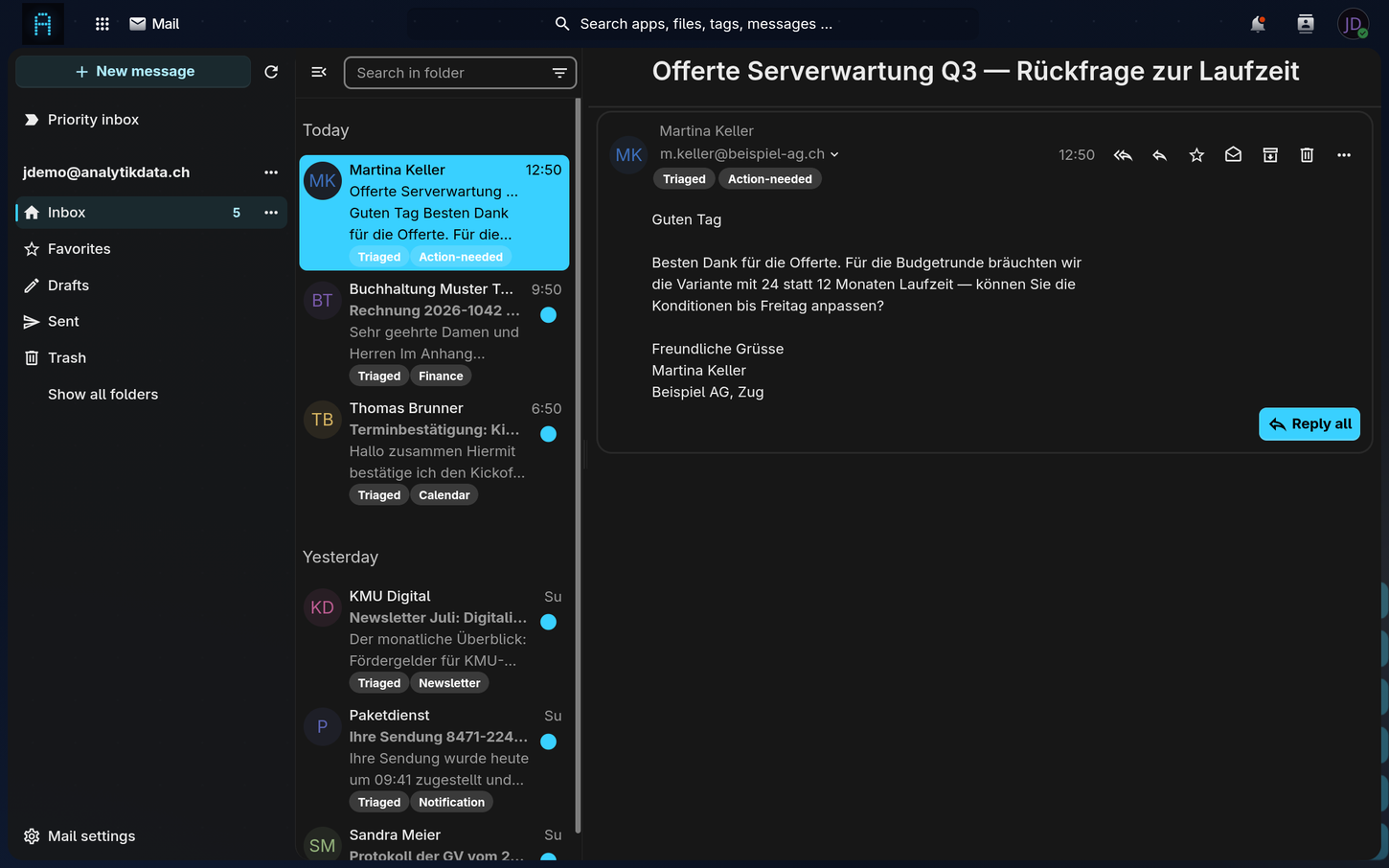
Every incoming mail is read, classified and summarized by the
agent before a human opens it: what is it about, what is expected,
how urgent is it. Routine gets treated as routine — what needs
attention gets it immediately. The inbox is no longer a pile but a
sorted overview.
No more mornings that start with an hour of inbox.
Demo mailbox with fictitious mails — the categories are set by the agent, exactly as in production
02
The archive answers questions — citing its sources
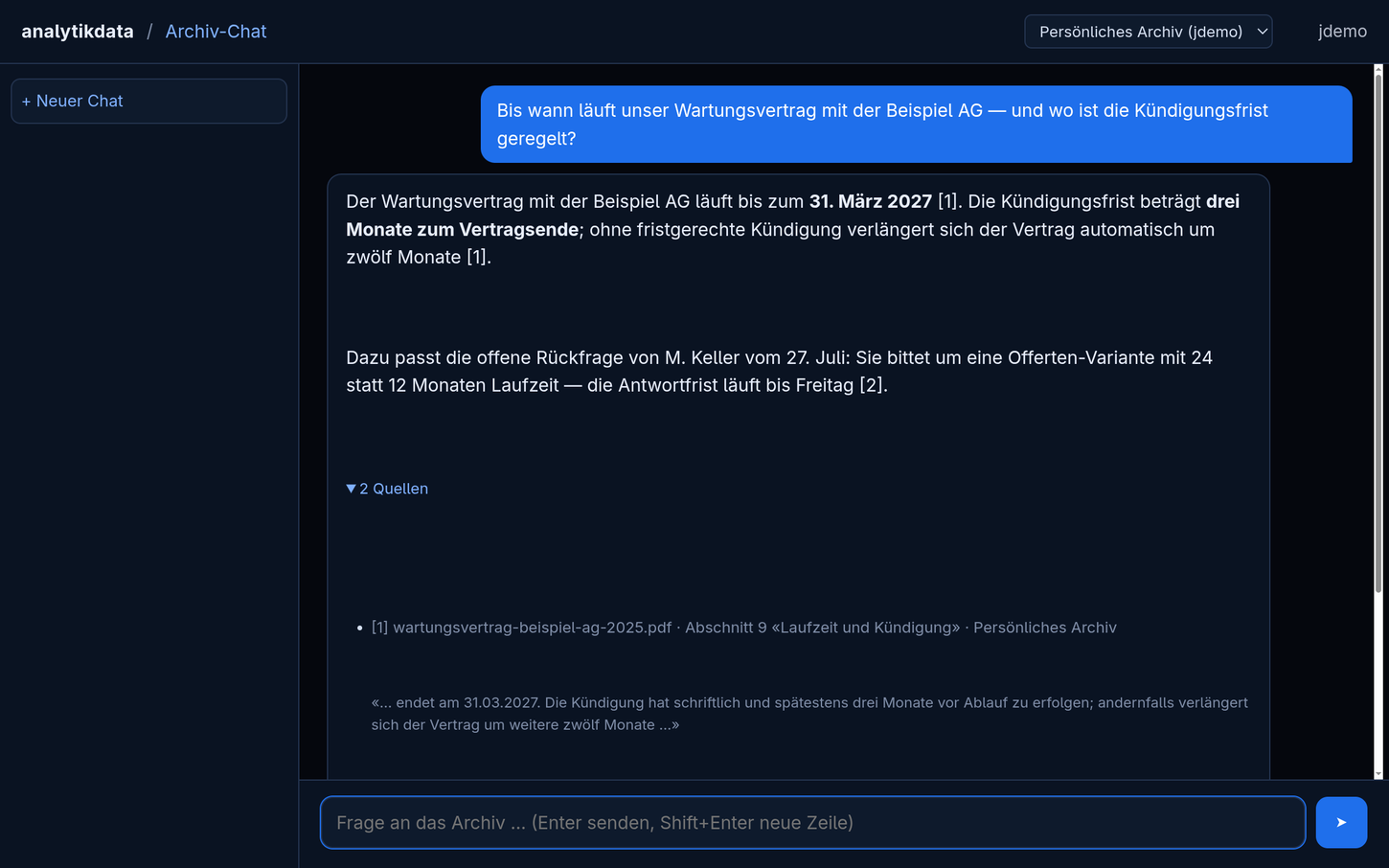
Contracts, project files, old mails, decisions: everything is
centrally indexed and searchable in a chat. The answer arrives in
seconds — always with a reference to the original document, so you
never have to trust it, you can verify it. «Where does it say that?»
is no longer a search task but a follow-up question. Each person has
their own archive; access to company collections is granted
explicitly — never inherited silently.
Knowledge that belongs to the company — not to individual heads.
Re-enacted with demo data while our GPU machine is under repair — layout and flow as in production: answers always cite the source documents
03
Decisions become documents — not memories
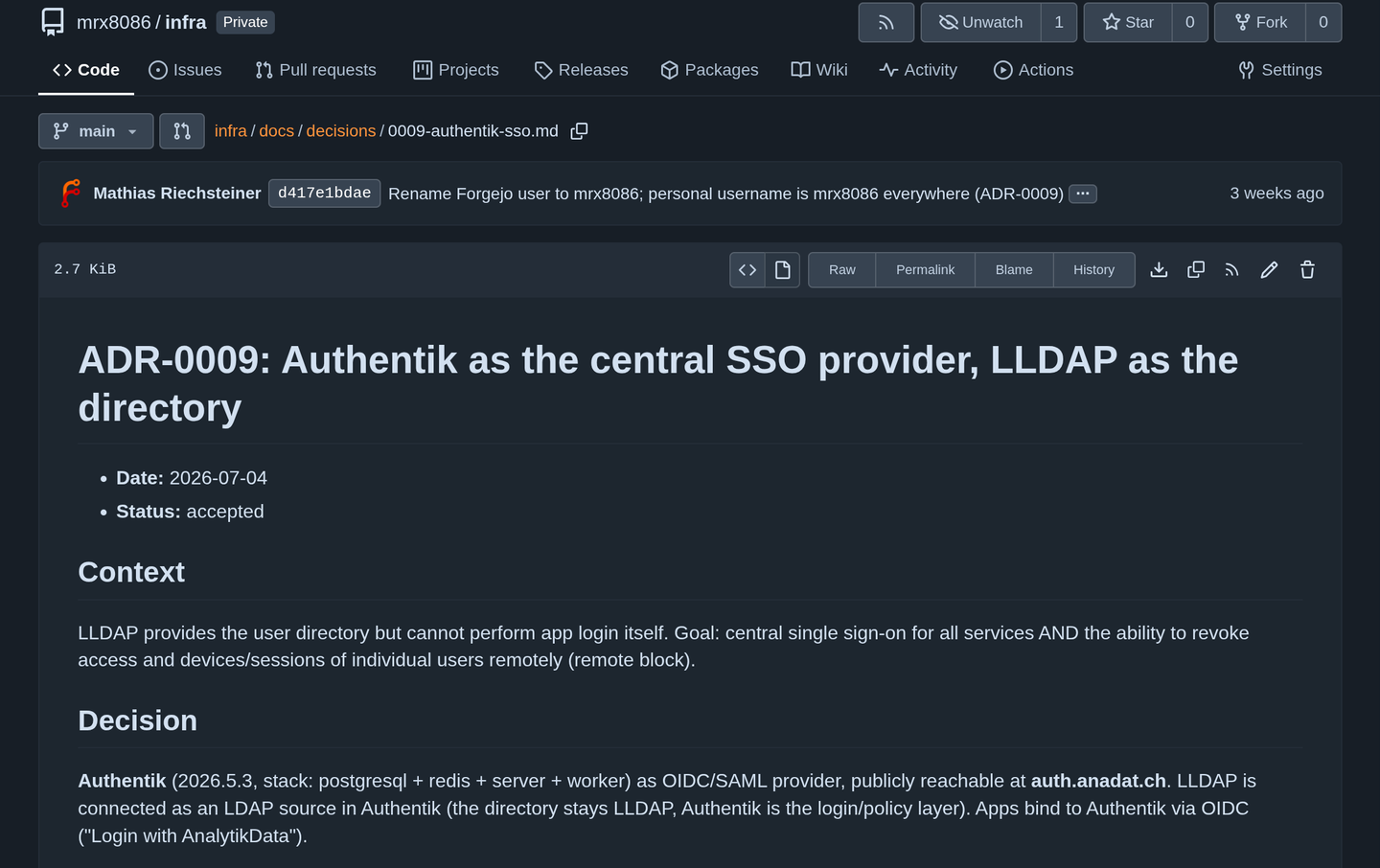
Every load-bearing decision gets written down: context, decision,
rejected alternatives. Every recurring procedure becomes a runbook.
That is not a bureaucratic ritual — it is the reason an agent, and
every new employee, immediately knows why things are the way they
are. Structure beats intelligence.
Traceable instead of «only the person who left knew that».
Real decision record in our own Git — status, date, change history
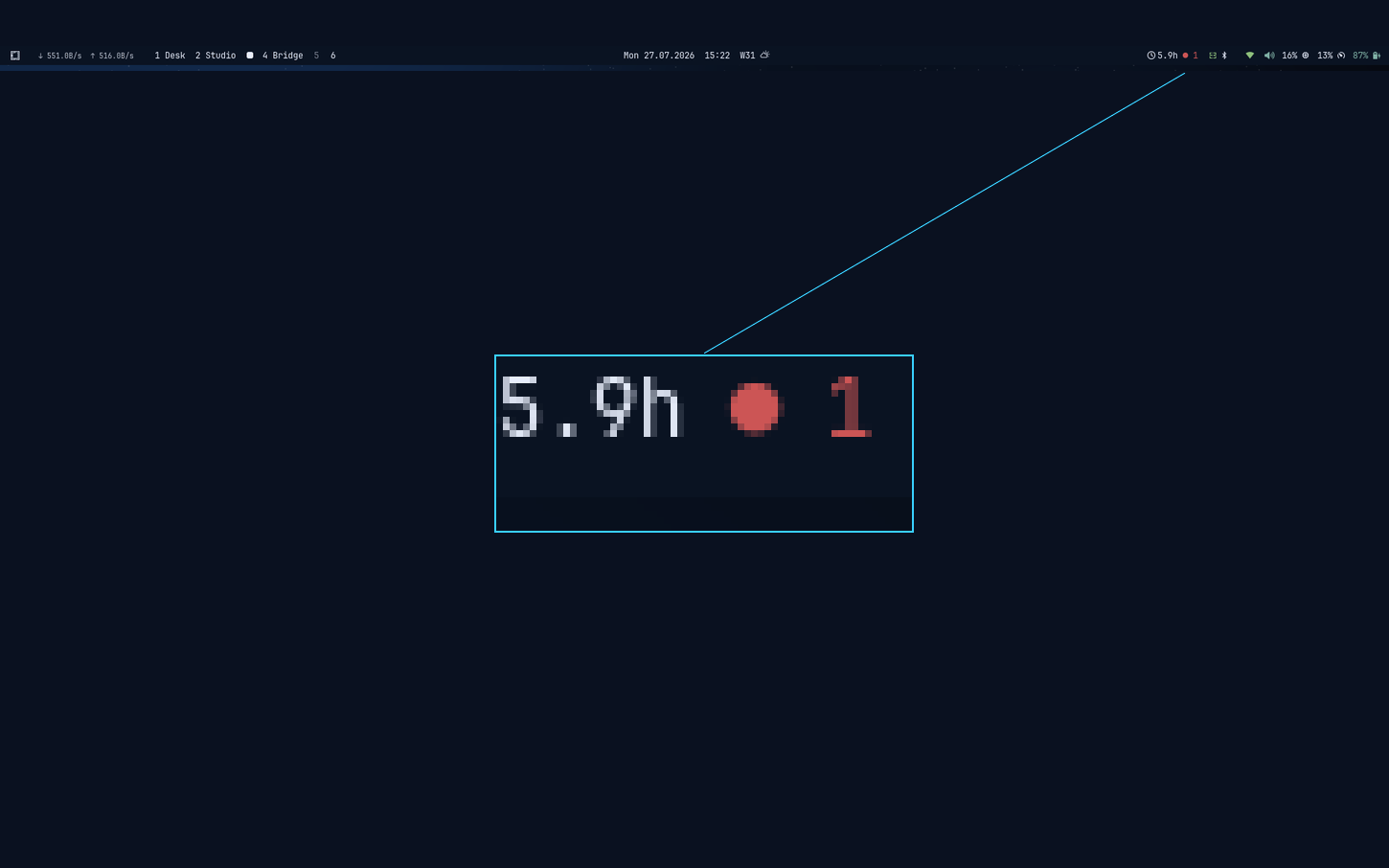
A check service looks at services, disks and the nightly backup
every two minutes. A dot in the taskbar shows green or red — and red
is additionally announced out loud. The very first alarm came ninety
seconds after go-live and caught a silently failed backup before it
could surface at the worst possible moment. The number next to it is
the second kind of watching: today's working hours, counted live —
every session is attributed to the right project automatically via
its working directory, including the AI agent's costs. No timers, no
timesheets.
Faults report themselves — and every hour knows where it belongs.
Captured during a real outage: the dot is reporting a dead GPU machine — exactly what it is for (green is the normal state). To its left: today's automatically tracked working hours.
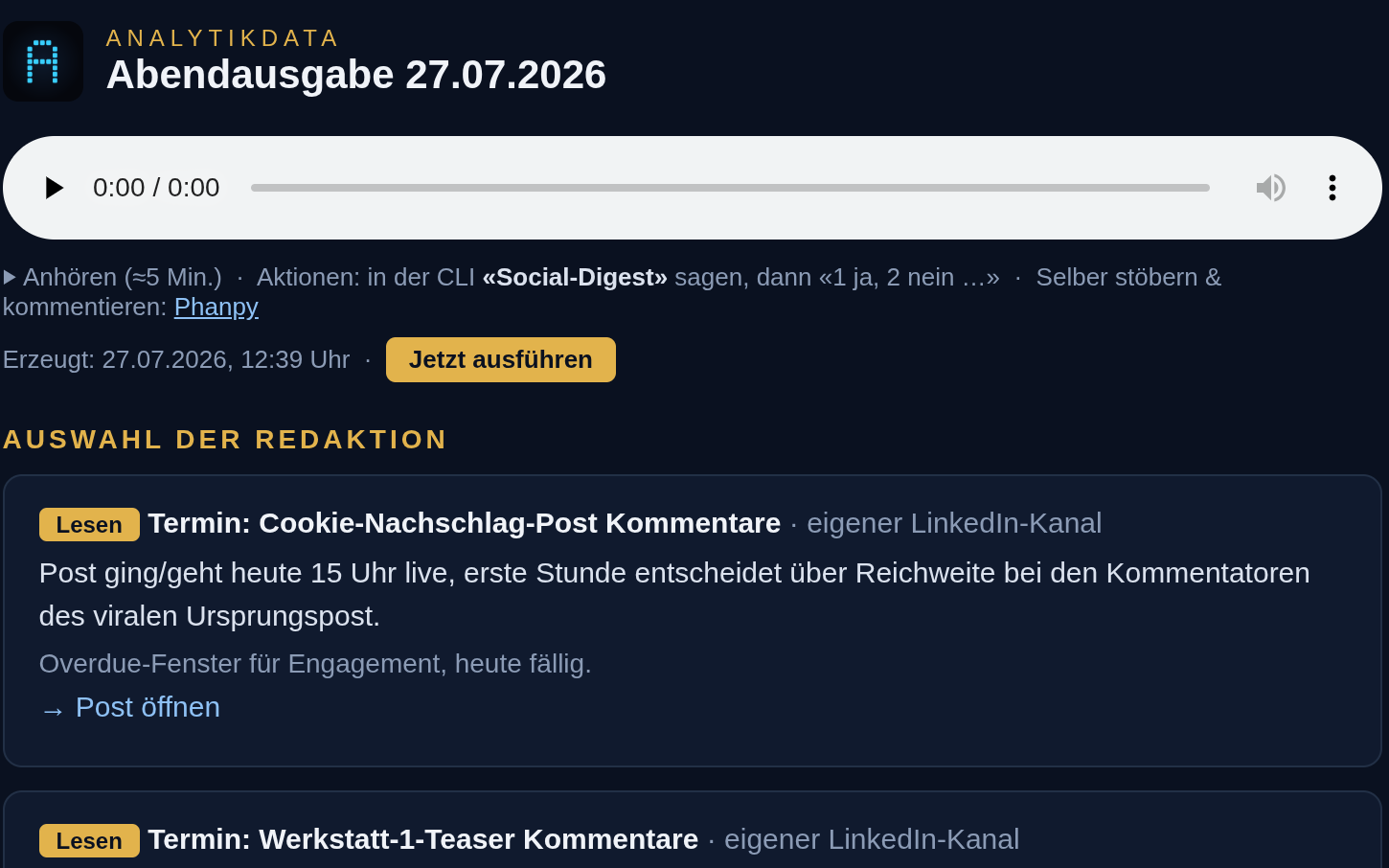
A blog post is written once — the machine does the rest:
publication on schedule, a reading voice generated on our own
hardware, covers from the design system, distribution to the open
networks, the newsletter. Twice a day a press review summarizes what
happened on our channels and what deserves attention — including the
deadlines coming up.
Visibility as a system, not a daily chore.
Channel digest, real edition — curated picks including upcoming deadlines
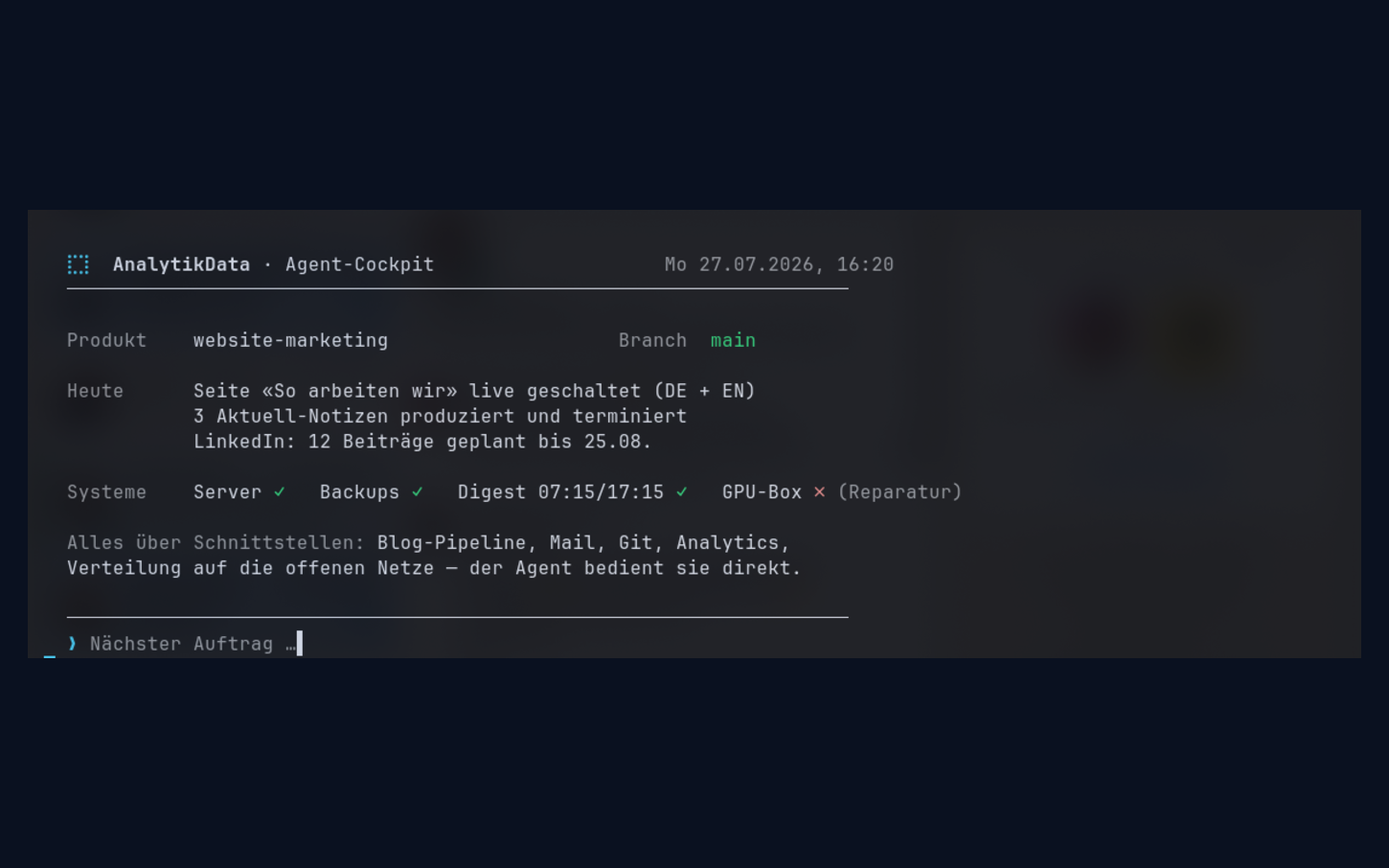
Behind every station sits the same principle: every tool in this
company was chosen by whether an agent can operate it completely —
interface before features, before price. What the agent cannot reach
does not exist for it. That is why the terminal is the cockpit,
configuration is text in a repository, and every change is
traceable.
Automation without a black box — every change stays auditable.
The status view in the terminal: this session's real daily summary — including the honest red cross for the machine under repair
For the six stations to carry weight, the same care sits underneath — unspectacular, but decisive:
One login for everything. Central single sign-on with passkeys and fingerprint, on the notebook and on the phone — and a single switch to revoke an access everywhere. The full story: SSO: one door for everything.
Passwords in our own house. Self-hosted password manager, in sync on every device — no subscription service holding the company's keys. Related: Who guards your passwords from your AI?
Internal services stay internal. Admin surfaces and cockpits are reachable only through our own VPN — down to the phone, tested from the outside instead of trusted from the inside. The lesson: The internal zone that was public.
What this means for your company
Nothing on this page depends on our size. Pre-sorting mail, making knowledge searchable, recording decisions, monitoring systems — these are the same building blocks we use to make SMEs AI-ready. The difference to «we now have AI too»: you can watch every station here running in production before bringing it into your own house — and the blog documents unfiltered what broke along the way and what it cost.
What is deliberately missing here
No tool catalogue and no magic. An AI that takes over a chaotic process produces chaos at higher speed — which is why every one of these stations starts with structure, not with a model. And at the decisive points, the final sign-off always comes from a human.