AnalytikData
  • Services
  • Coautra
  • How we work
  • Blog
  • News
  • Let's talk
DE
Ticker
All items →

Build in Public

News

Short notes from the ongoing rebuild — unfiltered and in real time. The long stories still appear on the blog.

The automated raw feed runs in the ticker (original language) — also installable as an app.

todayYour contacts on LinkedIn — do they belong to you?yesterdayDo you know which data your company collects?2 days agoIf your provider shuts down tomorrow — can you still read your data?3 days agoWho owns the login your company works with?4 days agoHow long are you down when your provider switches off?

11 September 2026· today

Your contacts on LinkedIn — do they belong to you?

Dot-matrix pictogram for this entry: Your contacts on LinkedIn — do they belong to you?

Your contacts on LinkedIn — do they belong to you?

The honest answer is no, and that is not a criticism of LinkedIn. Every platform works this way: it creates the relationship and it keeps it. If an account is suspended — accidentally, automatically, mistakenly — it is not only the posts that are gone. The list is gone. And nobody sends it to you beforehand.

For most companies this is the largest unsecured position in the whole business, and it appears on no risk list. You notice it only once you try to reach the same people without the platform.

The distinction is simple: rented is everything somebody else can switch off — followers, groups, ad accounts. Owned is what sits on your own address: a mailing list, a website, a feed anyone can subscribe to.

Honestly, about us: LinkedIn is still our largest channel, and that is exactly why it is our largest rented position. We write every piece on our own site first and link from there — and the short notes additionally go out over open networks that nobody can switch off.

The first step costs one afternoon: export your contacts while you still can. Then start a list that belongs to you and write the first piece into it. Even if it is only twenty addresses — twenty that nobody can take away from you.

Reactions

10 September 2026· yesterday

Do you know which data your company collects?

Dot-matrix pictogram for this entry: Do you know which data your company collects?

Do you know which personal data your company collects? Most do not.

Not out of negligence. It is because the data spreads out: a form on the website, a newsletter tool, a CRM, three spreadsheets on different laptops, the bookkeeping. Each harmless on its own. Together they add up to a picture nobody in the company has ever seen in one piece.

The test takes an hour and needs no lawyer. Sit down and write out where personal data sits. Not what is permitted — only where. Most people stop halfway through because the list grows longer than expected. That is exactly the result.

Because only this list makes the usual questions answerable. Who may access it? What happens when somebody requests disclosure? What do you delete when a customer leaves — and in how many places? Without the list those are guesses; with it they are tasks.

Here, every place that holds personal data carries an entry with a purpose and a retention period. Not because it looks tidy, but because an agent working for us could otherwise not know what it is allowed to touch.

Data protection does not start with the statement on your website. It starts with the question of what you actually hold. Begin with one line: the form on your home page.

Reactions

9 September 2026· 2 days ago

If your provider shuts down tomorrow — can you still read your data?

Dot-matrix pictogram for this entry: If your provider shuts down tomorrow — can you still read your data?

If your most important provider shuts down tomorrow — can you still read your data?

Most people say yes and mean: “It is all backed up.” Usually it is. Only the backup sits inside the provider’s system, in a format that only that system opens. That is a copy in the same sense that a spare key locked inside the car is a spare key.

The difference is the format, not the location. An invoice as a PDF will still open in ten years. A database dump only the provider’s software understands is worth exactly as long as that software exists. For contracts, bookkeeping and customer data that is the difference between an archive and a promise.

Here, the mail archive and the documents sit in open formats on our own servers, and the search across them runs on our own hardware — the same search that kept working on 4 September, when the large AI services went down.

Honestly, about us: we rent metal from a hosting provider and we buy cloud services. The difference is that for each of them it is decided in advance what the copy looks like and how long a move would take.

The test takes ten minutes and you can do it today: take one system, export everything, open the file on a different computer. If it does not open, you do not have a copy — you have a subscription.

Reactions

8 September 2026· 3 days ago

Who owns the login your company works with?

Dot-matrix pictogram for this entry: Who owns the login your company works with?

Who owns the login your company starts every morning with?

Most people have to think about it. Access hangs on an account at a large provider, the account hangs on a mail address, and the mail address hangs on the same provider. As long as everything works, nobody notices. It becomes visible on the day an account is suspended — and then it is no longer an IT question but an operating question.

An example that concerns many people in Switzerland right now: in the canton of Zurich the deadline to register with justitia.swiss — the platform for electronic legal correspondence — ran out on 1 September. Registration goes through AGOV. The convenient path is an app built on Google services. Anyone who does not want that uses a plug-in security key; they start at around 26 francs and some are built in Switzerland. One path is convenient, the other depends on nobody. Both work.

That is the whole point: sovereignty is not a question of where something sits. It is the question of whether your access survives losing the foreign account.

Honestly, about us: our domains sit with a US registrar, and our visibility on LinkedIn is rented like everyone else’s. The difference is not that we avoid it — we know, for every single point, how we would get out and how long it would take.

The first step takes half an hour: write down who has which access — humans and machines in the same list. Next to each line, note which foreign account that access hangs on. The lines with no answer are the good ones.

Reactions

7 September 2026· 4 days ago

How long are you down when your provider switches off?

Dot-matrix pictogram for this entry: How long are you down when your provider switches off?

How many days does your company stand still if your most important provider switches off tomorrow?

Hardly anyone knows that number. It is in no contract, it appears in no budget, and it usually gets asked on the day it is too late to ask. The 4th of September was such a day: ChatGPT, Claude and Grok went down worldwide at the same time.

On a day like that the only thing that counts at management level is how quickly you are working again without that provider. One day is annoying. Two weeks is a business risk — and the difference between the two is not a technical question but a decision someone has to have made beforehand.

What kept running here that Thursday is what computes in our own house: sorting the mail, searching the company archive, dictation. Since July without interruption. Not because we avoid cloud services — we buy them ourselves — but because for each one it is decided in advance how long we can manage without it.

The test takes ten minutes and needs no consultant: write down your five most important services. Next to each, one number — how many days until you are able to work again without it. The line with the largest number is your next project.

Which number is at the top of your list? Send us two lines and we will tell you what can be halved within four weeks.

Reactions

Older notes

September 2026

05/09/2026The receipt hunt is cancelled

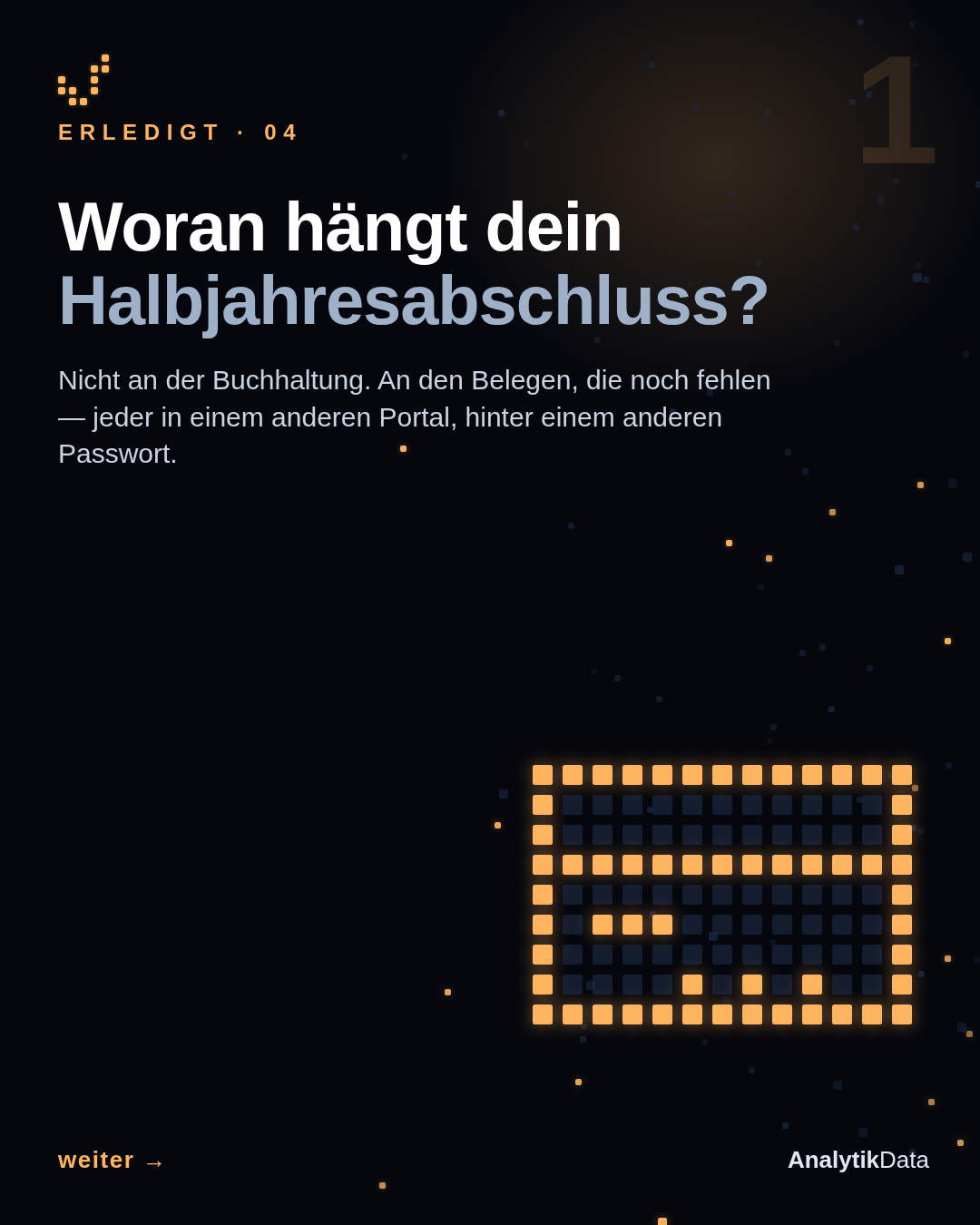
What holds up a half-year closing? Not the bookkeeping.

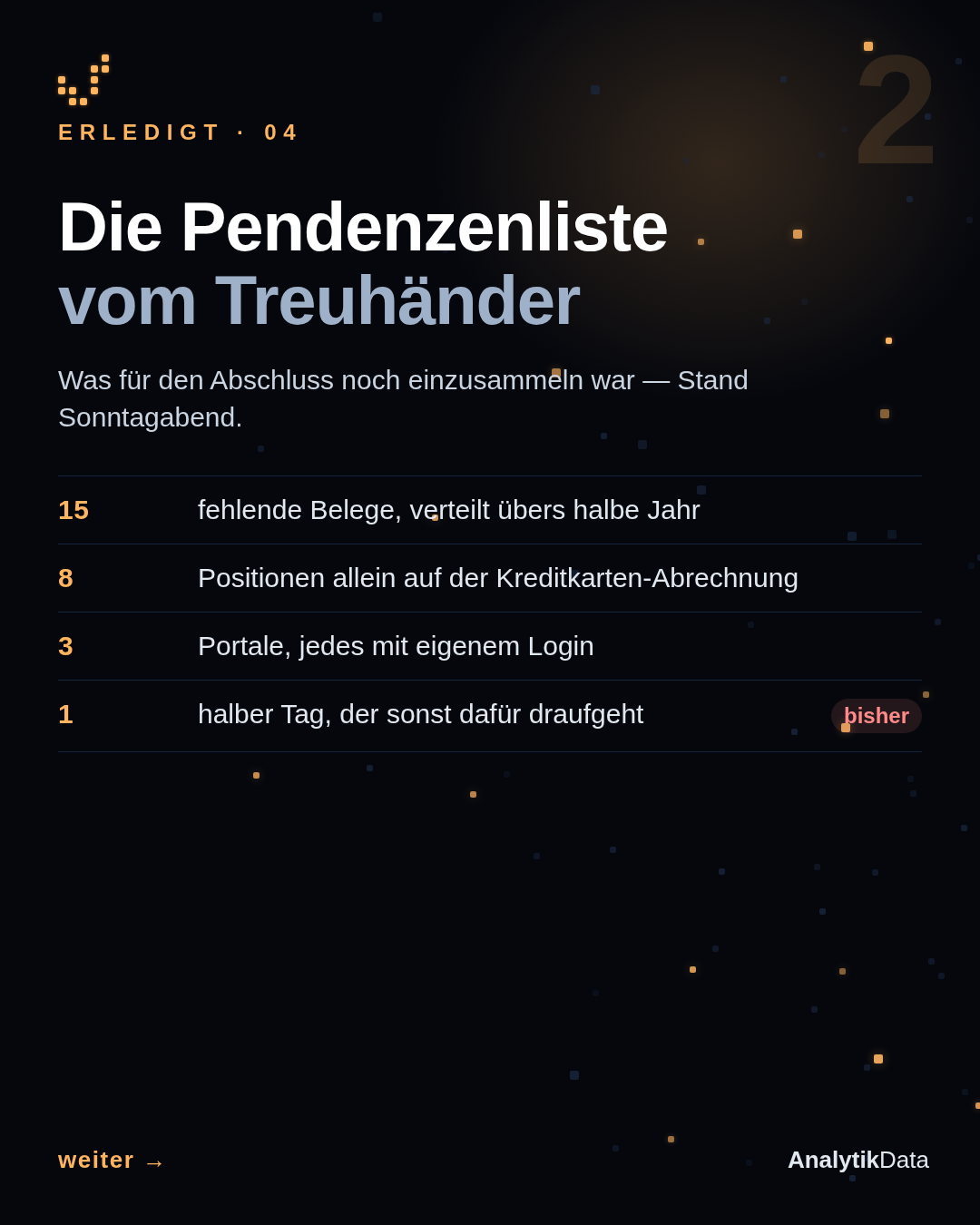
It is the receipts that are still missing. Credit-card receipts, subscription invoices, expenses — each in a different portal, behind a different password. Your fiduciary is not waiting for numbers, they are waiting for paper. And collecting it costs you half a day you do not have.

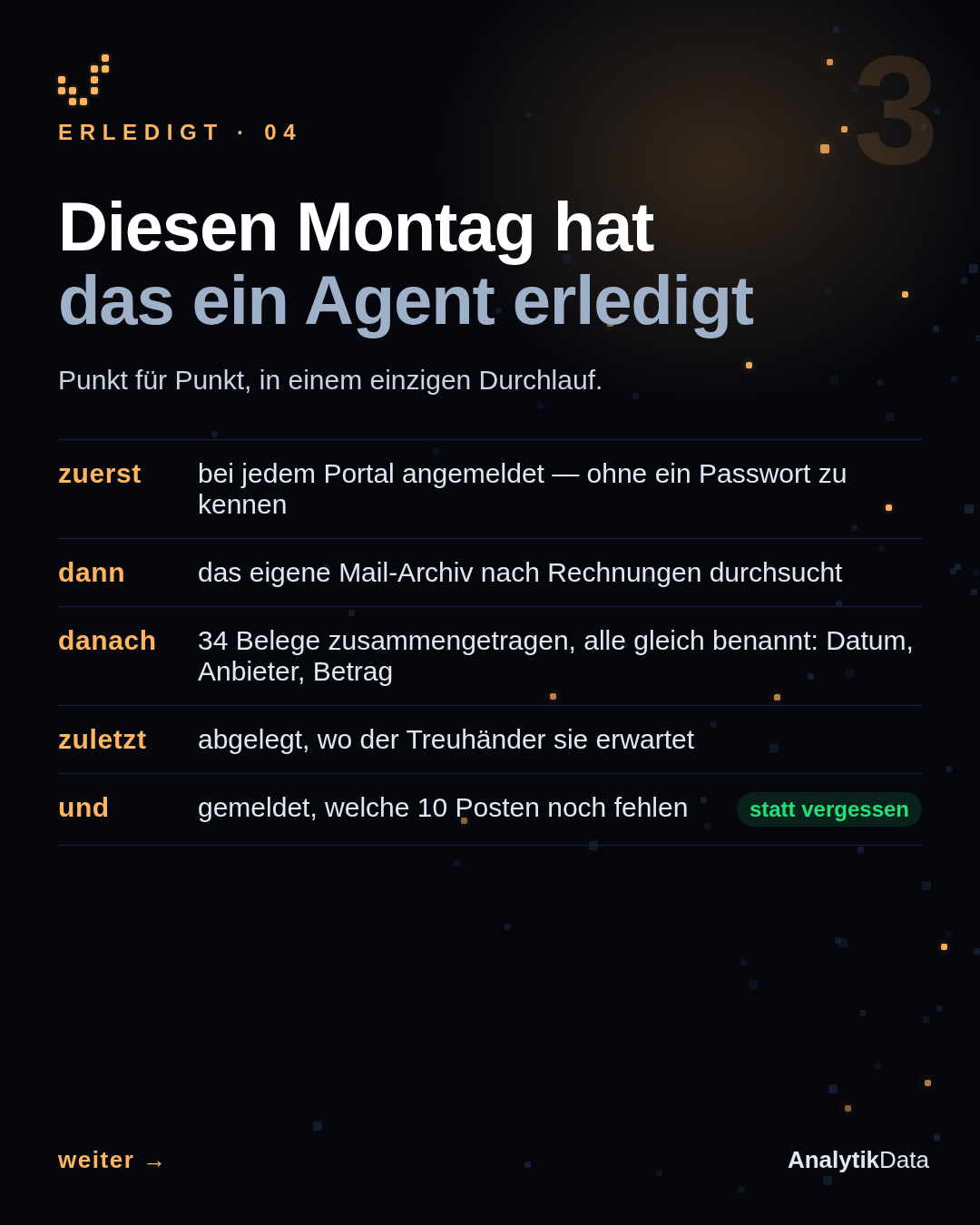
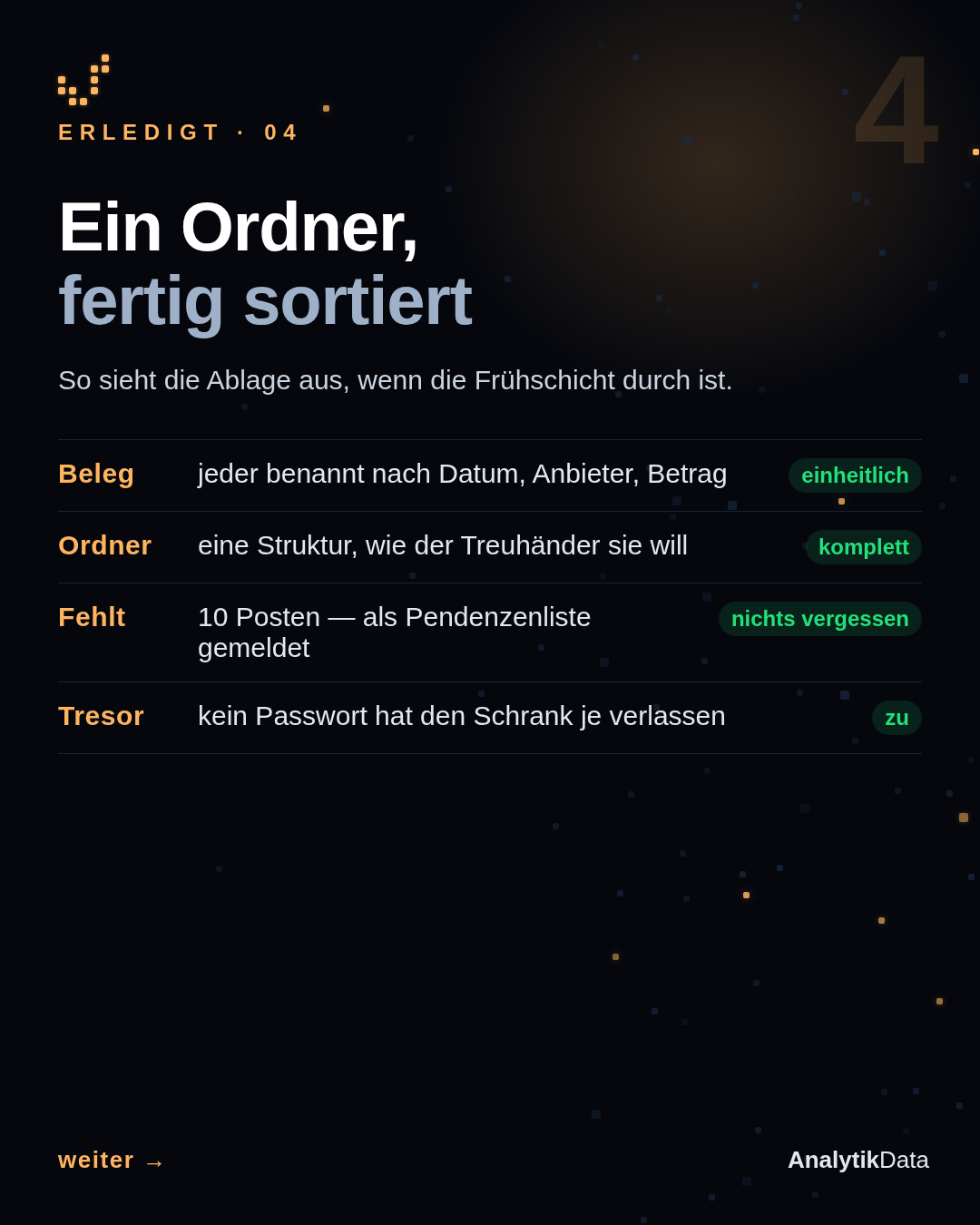
This Monday that list was ours. An agent worked through it in a single run: logged in to three portals — without ever seeing a password, those stay in the vault. Searched our own mail archive for invoices, gathered 34 receipts, named them all the same way (date, vendor, amount), filed them the way the fiduciary wants them. And reported which ten items are still missing — instead of someone noticing in October.

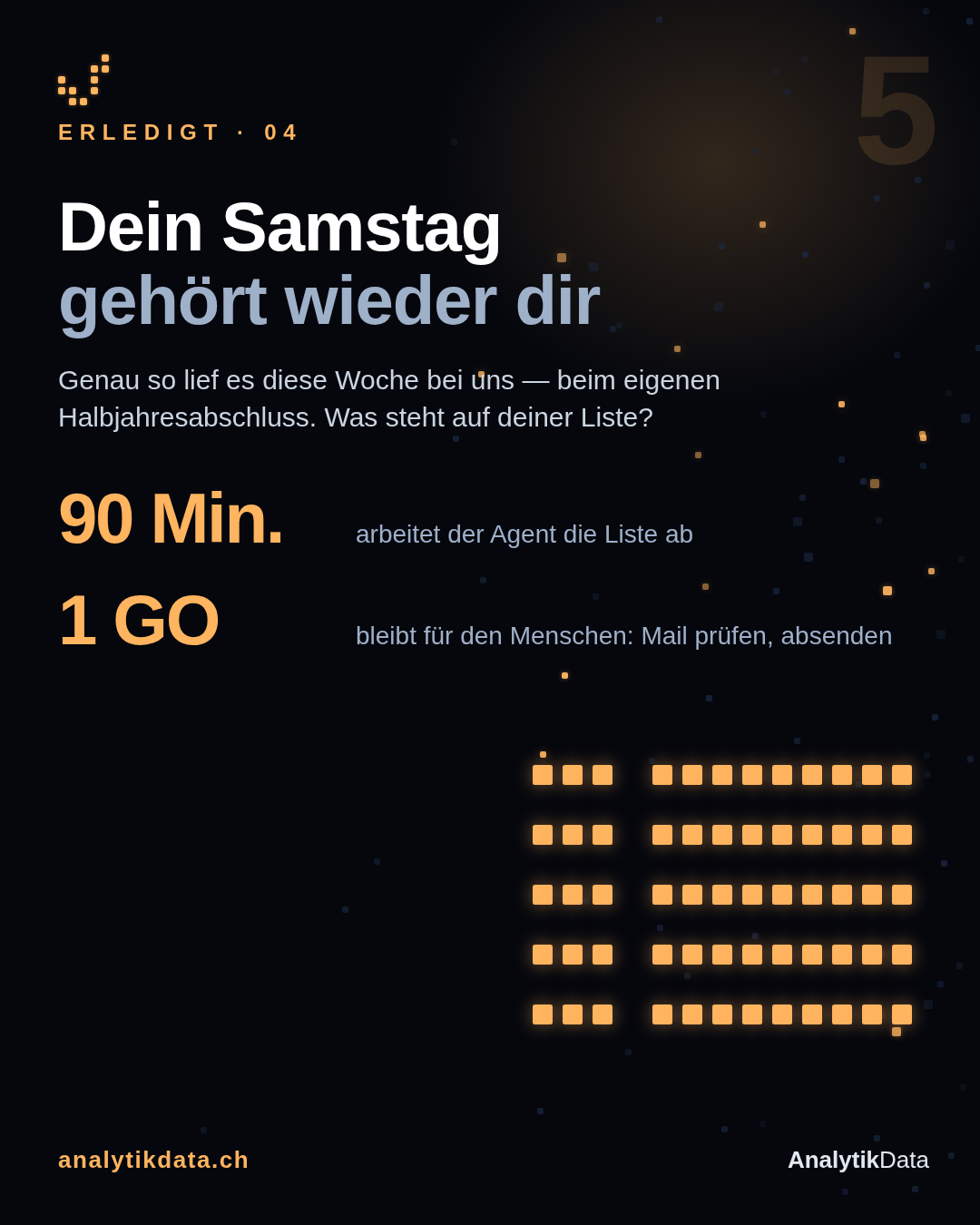
34 receipts, 90 minutes, zero passwords seen. The only human touch: reviewing the reply mail and saying GO. Your Saturday belongs to you again.

What is on your closing to-do list? Send us two lines — we will tell you what you could hand off.

The five pages, for browsing:

Page 1: What holds up your half-year closing?

Page 2: The fiduciary’s to-do list

Page 3: This Monday an agent did it

Page 4: One folder, fully sorted

Page 5: 90 minutes of agent, one GO from a human

Reactions
04/09/2026Who guards your passwords from your AI?

Who guards your passwords from your AI?

You sign in ten times a day. Password, Face ID, fingerprint — nothing runs without it. Naturally.

And then you let an AI agent work for you. It needs the same accounts: mail, bookkeeping, customer data. Most people simply hand it the passwords.

At our place the agent never sees one. It asks, a human approves, a vault fills in. The agent gets the result, not the key. And the vault sits on our own servers, in Switzerland.

That is not security decoration. It is the precondition for letting an agent touch real systems at all. How it works: AI without your keys.

Reactions
03/09/2026Why do you have to make three phone calls to learn a price?

Why do you have to make three phone calls to learn a price? You don’t.

The usual routine: fill in a form. Two days later somebody calls and asks questions. Then a meeting. Then the quote. You wanted a number, you got a sales process.

We asked ourselves why we should do it that way — and found no good answer. So the price is on the website. Eight questions, 60 seconds, an honest range, right on your screen. No callback, no sales pitch.

A price you only learn after two meetings is not a price. It is a negotiating position. Try it: web analytics calculator.

Reactions
02/09/2026How fast can you find a contract from 2019? Honestly.

How fast can you find a contract from 2019? Honestly.

First the folder on the shared drive. Then the mail attachments. Then you ask a colleague whether she remembers where it was filed. Twenty minutes later you have a file — and you are not sure it is the latest version.

Those twenty minutes cost nothing, says the bookkeeping. They only cost every day, for everyone, and nobody bills them.

At our place you type the question into the company chat and get the answer with its source. One minute. Paper too: putting it on the scanner glass is enough — a minute later it can be queried.

Start with a single folder, not the whole archive. The rest follows by itself the first time somebody finds something. How we approach old files: legacy cleanup.

Reactions
01/09/2026Who really visits your website? Your tool doesn't know.

Who really visits your website? Your tool doesn’t know.

500 visitors this month, says the dashboard. Sounds good. Except: part of them are bots nobody filters out. Another part clicked the cookie banner away and never shows up at all. And the data sits with an ad corporation in the US.

What remains is a number you cannot base any decision on. It still appears in every monthly report.

There is another way: count anonymously, evaluate honestly, hosted in Switzerland. Without a banner, because there is nothing to consent to. That is exactly how we measure our own website — Sunday’s two-month review was built on it.

How many of your marketing numbers would you sign off on if you knew how they were made? Calculator and package: web analytics.

Reactions

August 2026

31/08/2026How many hours does a single blog post cost you?

How many hours does a single blog post cost you? With image, audio and distribution to every channel.

Writing is the least of it. Then comes the image. Then the audio version. Then the same thing four times into four channels, each cut differently. Half a day — and the text was finished after an hour.

For us it is one job. The post, its image, the audio version, the announcements in the channels: the same machine, one run. This very entry was scheduled by it — weeks ahead, on a single planning day.

We sell nothing that does not run in our own daily business. What that looks like for your marketing: channels you own.

Reactions
30/08/2026What costs the most in a dispute? Not the lawyer.

What costs the most in a dispute? Not the lawyer. The sorting.

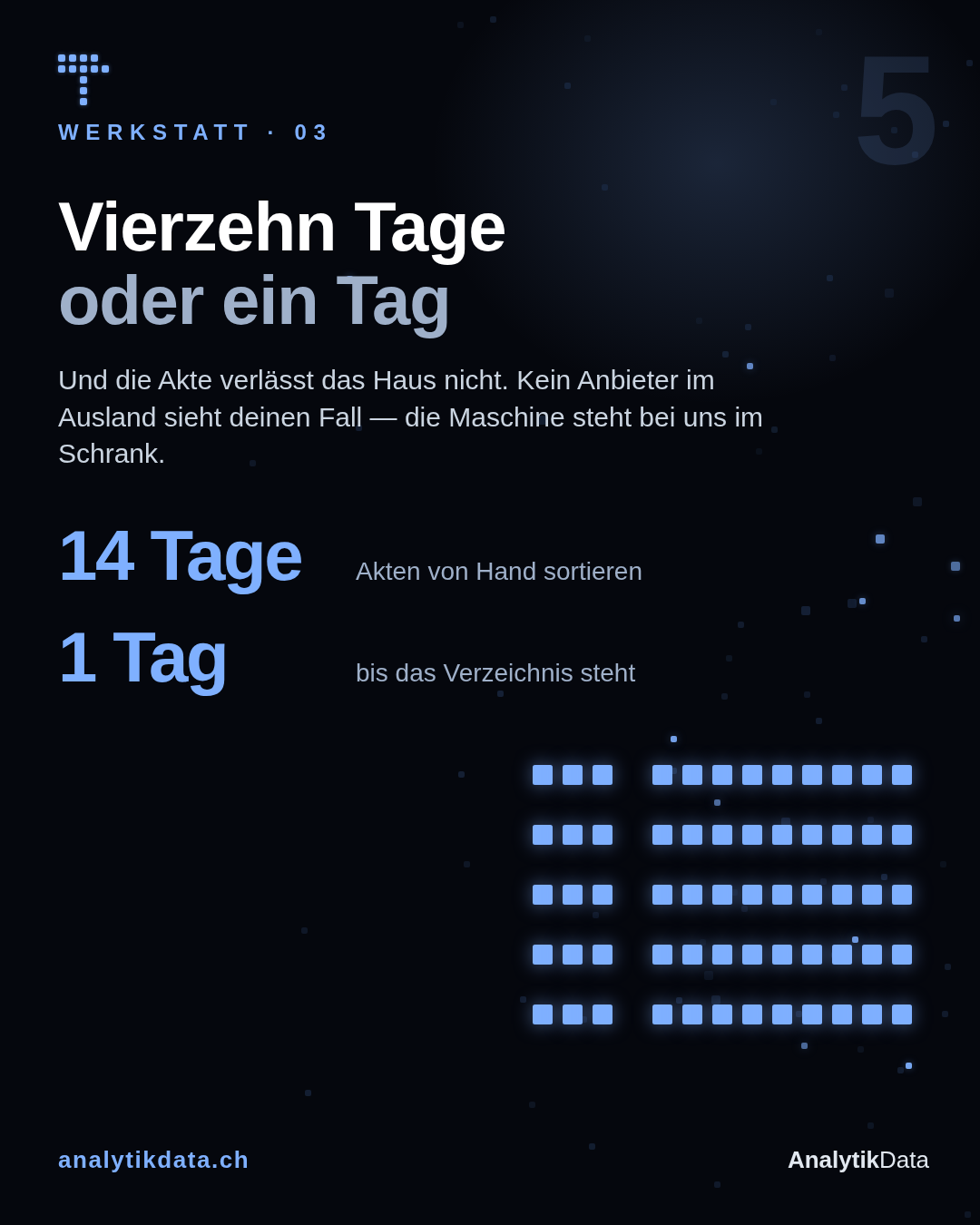
One binder. 2,400 pages. Four years of history. Contracts, amendments, invoices, mail threads, a few phone photos. Before anyone argues the merits, someone has to read all of it and put it in order. That work is billed by the hour — and it is the dullest part of the whole case.

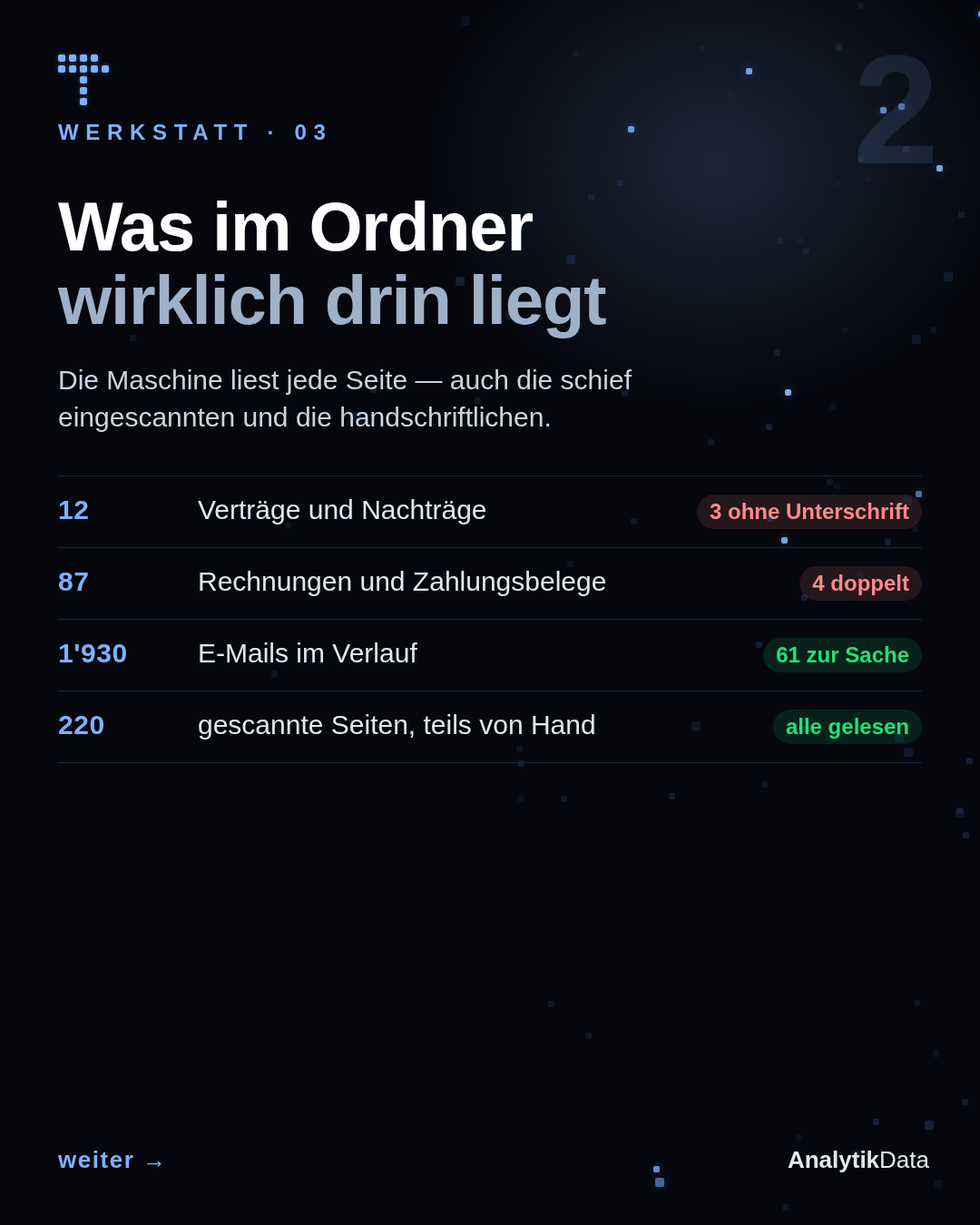
Here is what the binder looks like after a machine has read every page:

  • 12 contracts and amendments, 3 of them unsigned
  • 87 invoices and payment records, 4 of them booked twice
  • 1,930 emails in the thread, 61 of them relevant
  • 220 scanned pages, some handwritten, all read

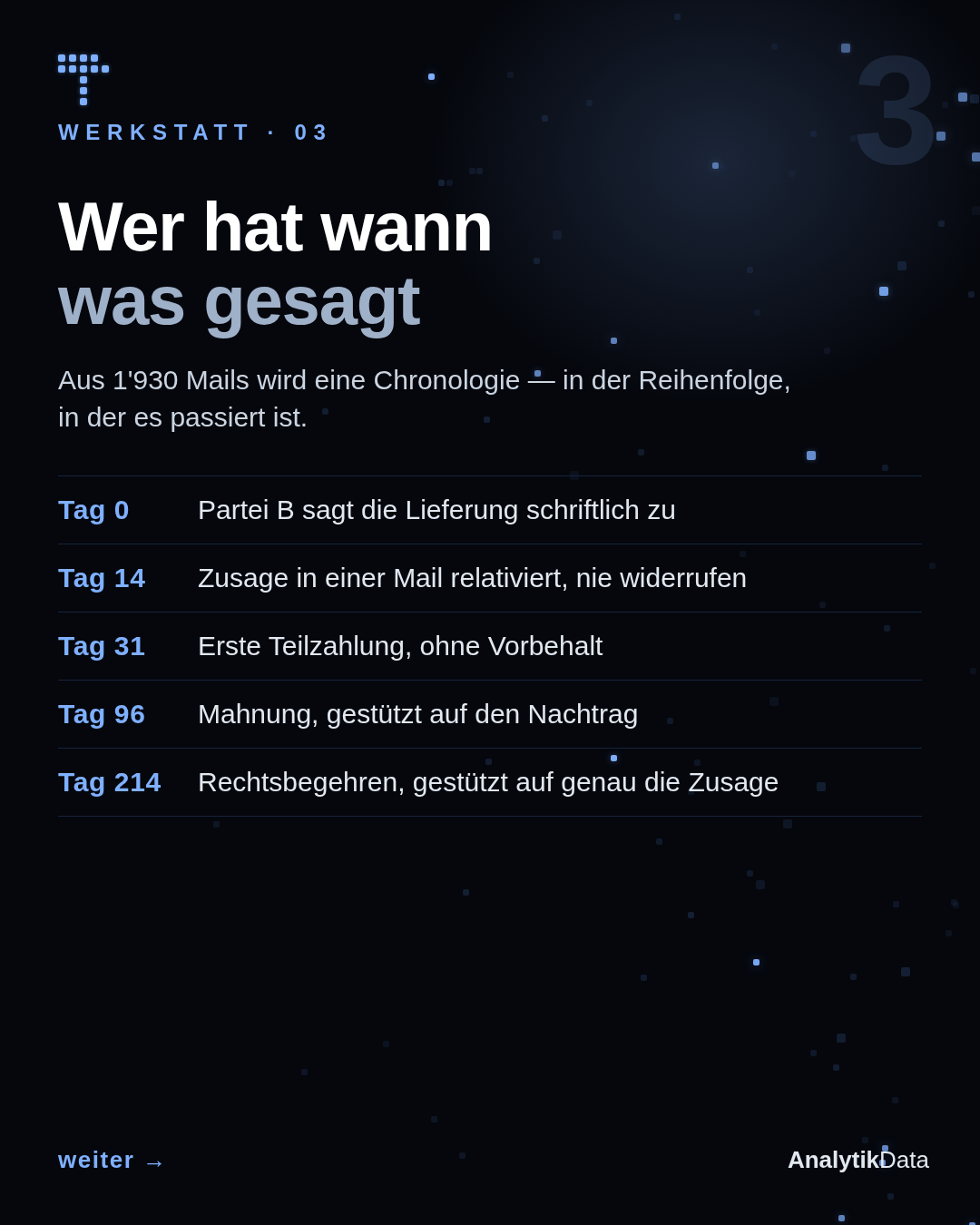
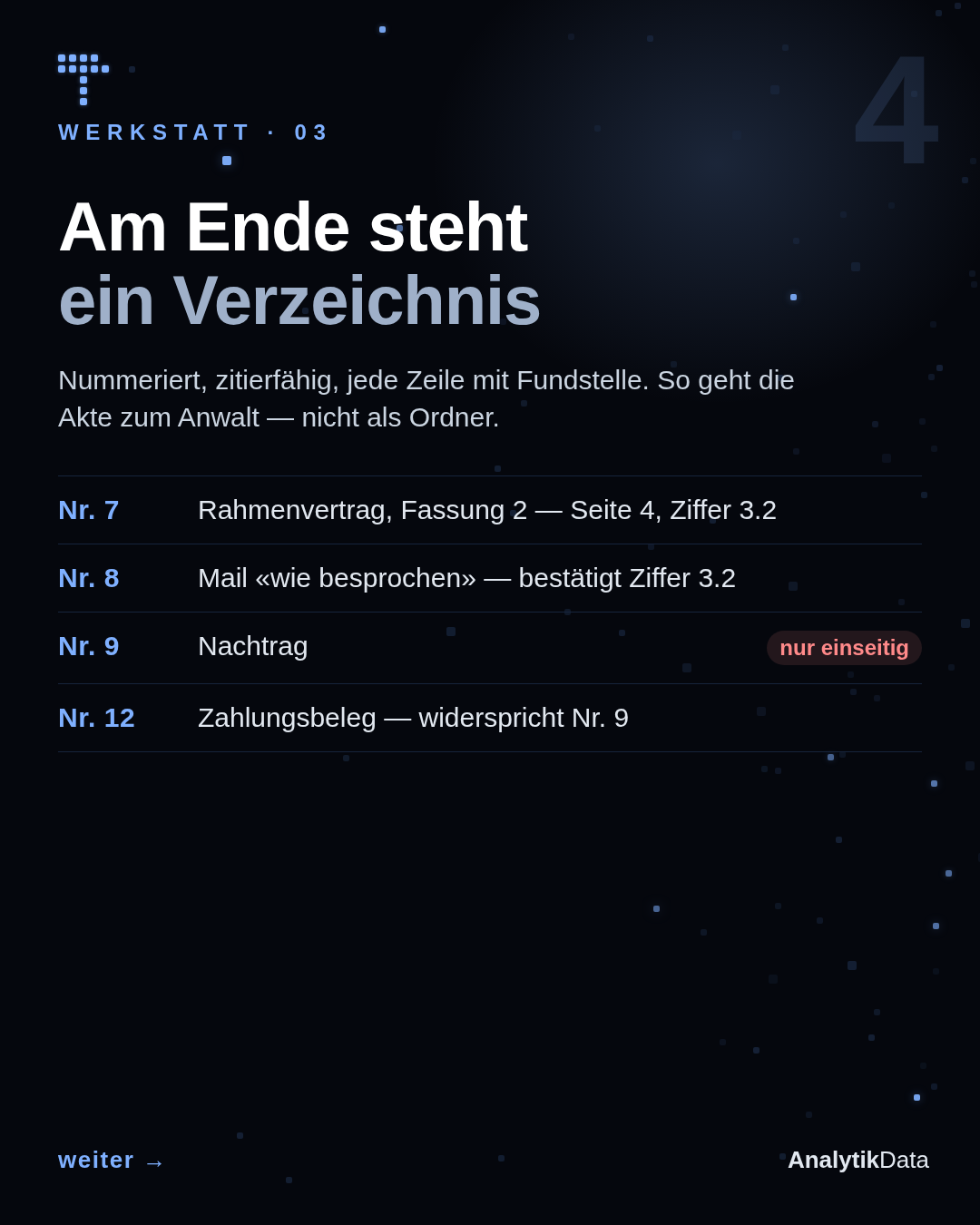
It gets interesting where documents turn into a sequence. Day 0, the other side confirms delivery in writing. Day 14, they qualify it in an email — but never withdraw it. Day 31, they pay a first instalment, without reservation. Day 96, they send a reminder based on an amendment only one party signed. Day 214, the claim arrives, resting on exactly the promise from day 0.

What you end up with is not a binder but an index. Numbered, citable, every line with its source. No. 9 is the one-sided amendment. No. 12 is the payment record that contradicts it. Your lawyer starts where they would otherwise be after two weeks.

The case above is invented. Names, dates and amounts match no real file — the method does. And the part that matters most: the file never leaves the house. No contracts, no client data, no payroll goes to a provider abroad.

The same thing works outside the law: checking a set of books, matching receipts to payments, working out who promised what and when.

Do you have a binder like that? Tell us what is in it — we will tell you what can be made of it.

Flip through — the five pages from the case:

Page 1: What costs the most in a dispute? Not the lawyer.

Page 2: The binder in numbers

Page 3: Who said what, when — the chronology

Page 4: The citable index

Page 5: The file never leaves the house

Reactions
29/08/2026How many software subscriptions does your company pay for? More than it uses.

How many software subscriptions does your company pay for? More than it uses.

Per seat. Per month. Per module. Plus the tool only one person really needs, and the other one that has quietly kept running since the project ended in 2023.

The bill grows silently, because cleaning up is nobody’s job. And because every single line item is too small to catch anyone’s eye.

We build companies their tools ourselves. Once, tailored, no subscription per click. On their own servers, in Switzerland. That is not worth it for every tool — but for the three or four that carry the daily business, it almost always is.

The first step costs one hour: list all subscriptions, sorted by “is used” and “is paid”. The difference is your budget for the rebuild. How we approach it: legacy cleanup.

Reactions
24/08/2026Tomorrow LinkedIn locks your account. Now what?

Tomorrow LinkedIn locks your account. Now what?

All gone. The followers you built over years were never yours — you rented them. You do not know their addresses.

A newsletter is yours. Your own website is yours. The rest is a shop window, and shop windows can be cancelled.

How we solved this for ourselves — hub and spokes, what we own and what we merely borrow — is in the post Channels you own. The test question for your company: if your most important channel changes the rules tomorrow — what is left for you?

Reactions
22/08/2026Where does your company start with AI? Small.

Where does your company start with AI? Small.

Not with the strategy that takes half a year. Not with the tool that can do everything and that nobody opens any more after three months.

Take the one process that annoys you today. Inbox. Quotes. Filing. Four weeks, one measurable result — then the next one.

The reason is unromantic: a small process can be understood completely. A large project cannot. And what you do not understand you cannot automate — you can only buy it.

That is how a company becomes AI-native: step by step, not in one go. Which process annoys you most this week? That one is yours.

Reactions
21/08/2026Credit card statement done yet? Ours is automatic.

The credit card statement arrives, and the receipts for it are everywhere: in the inbox between newsletters, as a scan, somewhere in the filing. In every company someone then spends an hour searching.

At our place a graphics card in the office does it. It reads amount, date and sender from the mail and files the receipt where it belongs — 1.3 seconds per receipt. No receipt leaves the building.

That is not a promise but a measurement — on our own bookkeeping, every answer checked by hand: reading out fields 97 % exact, sorting 100 real mails 92 % right, transcribing paper receipts 92.9 %. In 4 out of 5 disciplines the graphics card beat Claude Fable 5, the top cloud model. All numbers and all caveats are in yesterday’s LAB report.

Want this for your company? I am happy to walk you to this result.

Reactions
07/08/2026Web analytics without a cookie banner — now a service

The most-discussed piece on our channels by far was not a product announcement but a design decision: this website has no cookie banner. Yesterday the full post went live — how it works technically and legally, and what you deliberately give up.

The most frequent question since, publicly and privately: “Would that work for us?” The answer, in most cases: yes. The banner is only mandatory where visitors are tracked — if you count anonymously instead, there is nothing to ask. Everything better content and measurable marketing require, cookie-free measurement delivers in full.

So it is now a service: web analytics without a cookie banner — self-hosted analytics (Umami) on Swiss hosting or your own infrastructure, migration from Google Analytics included, and at the end the consent dialog disappears. Fixed price, set up exactly the way we run it ourselves — this website is the reference.

Reactions
05/08/2026Two thirds of our «visitors» were machines

Our dashboard reported visitors from the US — at two in the morning. On closer inspection: Chrome on «Windows 7», zero seconds of dwell time, and every hit coming from the same Azure datacenter in Virginia.

So for one week we audited every single session. The result: 107 «visits» by raw count — 29 humans. Two thirds of our traffic were crawlers that execute JavaScript and therefore pass every common bot filter. In the AI era that is the normal case: machines reading for machines, dutifully counted as an audience by the statistics.

Our consequence: we count engagement-based now. A session only counts as human after ten seconds of dwell time or a real interaction — and the weekly report lists bots and humans separately, on purpose. Smaller numbers, but true ones.

This audit was only possible because we run our measurement ourselves — cookieless, banner-free, every session inspectable. With a black-box statistics product we could never have cross-examined those nocturnal Windows 7 visitors. Why that is also the more relaxed path legally is this week’s story on the blog.

Reactions

July 2026

31/07/2026Every working hour knows which project it belongs to

Next to the monitoring dot in our taskbar sits a number: today’s working hours, counted live. Nobody started a stopwatch for it — and nobody will have to reconstruct a timesheet on Friday.

The principle behind it is beautifully simple: work always happens in the directory of the project at hand — so every working session knows by itself where it belongs. A small service mines the work logs hourly and keeps the books: hours per project, rate, and — because an AI agent works alongside us — its costs too, attributed token-exact to the right project. No timer, no back-filling, no month-end guessing.

A dashboard delivers the weekly picture: which mandate got how many hours, what the AI cost along the way, what is billable. The honest answer to «what does an AI hour really cost?» is in there at any moment — not as gut feeling, but as a ledger entry.

For clients this means billing transparency that does not rely on memory. What it looks like day to day is shown at the station «The computer keeps watch» on our new page How we work — the hour count is already visible in the taskbar image there.

Reactions
29/07/2026Our server blocks attackers who never attacked it

For fifteen years the standard doorman for Linux servers was fail2ban: it reads your own logs, counts failed attempts and bans whoever rattles the door too often. Solid — but it only knows the attackers who knock on your door.

This month we replaced it across our fleet with CrowdSec. The principle is the same, with one decisive addition: detected attacks are shared with a worldwide community — as plain IP reports, never logs or content — and in return the server pulls the blocklist built from everyone’s reports. Anyone who misbehaved somewhere in the world is turned away here before their first attempt even lands. Neighbourhood watch instead of lone fighter.

The migration was uneventful — except for two snags worth passing on: the local API wanted the same port as a Docker service (fix: move the port, then install the firewall bouncer). And current Debian no longer writes a classic auth.log — the setup wizard detects this and correctly reads the system journal instead.

Why no antivirus, no heavyweight intrusion-detection system, and what a one-person fleet actually needs — the bigger security story is coming as a blog post of its own.

Reactions
22/07/2026The first alert came after ninety seconds — and it was real

Since this week the notebook’s taskbar shows a small dot: green means everything on our server is fine. Red means something is broken — and a computer voice additionally announces it out loud, so it doesn’t starve in the corner of the eye.

The check service looks after the services, the disks and the nightly backup every two minutes. Ninety seconds after going live, the first alert came in — and it was real: last night’s backup had failed. Silently and unnoticed — the backup itself was there, but the cleanup step was stuck on an orphaned lock from the previous evening.

Without the dot we would only have noticed when we actually needed the backup. Which is to say, at the worst possible moment. As it was, it took five minutes to repair and harden against repeats.

Self-hosted means self-responsible — but not alone: the machine keeps watch with us. How the whole chain works, from the check script through the VPN to the speech output, we’ll tell in more detail on the blog soon.

Reactions
20/07/2026Sundays, in your inbox too

It has existed since early July, and we never announced it: our newsletter. Time to catch up.

Subscribers get new blog posts and the Sunday edition as e-mail — nothing more. No “offers”, no third party reading along: the list runs on our own server (Listmonk, open source), the mails leave our own house, and the subscription ends with one click on the unsubscribe link. Double opt-in, it goes without saying — nobody lands on the list unasked.

The signup field sits below every blog post.

And because a newsletter should do more than redeliver what already exists, we are working on a small head start: subscribers will soon read new posts three days before everyone else. As a thank-you — not as a paywall.

Reactions
18/07/2026Signed like an NFT — just without the blockchain

Since this week, every note here carries its own dot-matrix image. What emerged almost in passing: a small series of works. Deterministically generated from a seed — same seed, same pixels, provably reproducible — and each work declared an edition of 1/1.

At “digital artworks, edition, authenticity” many people immediately think of NFTs. We asked ourselves the question seriously — and decided against. Because what an NFT technically proves is exactly three things: who issued a work, when, and who owns it. All three work without a blockchain:

Who: Every work has a provenance statement (title, edition, seed, SHA-256 checksum), signed with an Ed25519 key. The public key sits on this website — verification is a one-liner with standard tooling (ssh-keygen -Y verify).

When: The checksums live in our Git history, in web archives — and from now on in every entry of our RSS feed. Thousands of feed readers and archives thereby become independent witnesses to the timestamp. It is the old notarial principle of “notice in the newspaper”, just machine-readable.

Whose: Ownership changes hands via a signed transfer statement — the way the art market has traded photography and video art for decades: certificate of authenticity instead of token. Scarcity is guaranteed not by mathematics but by reputation. For a brand built on traceability, that is no disadvantage.

The complete catalogue — every work with seed, checksum and signature — is now available at analytikdata.ch/works.

And should tokenization ever become worthwhile: the signed statements are exactly the metadata a mint would need. We lose nothing by deciding later.

Reactions
17/07/2026You can now find us on the open networks, too

A short announcement in our own cause: these notes — and the blog posts — now reach you outside the big platforms as well.

Bluesky: @analytikdata.ch — our domain is the username there. The identity lives in the protocol, not in a purchased checkmark.

Fediverse/Mastodon: @aktuell@social.anadat.ch — not an account on someone else’s platform, but an instance of our own: a node of the network that we run ourselves.

RSS: /en/news/rss.xml for these notes, /rss.xml for the blog — for everyone who never gave up on feeds. Rightly so.

There is nothing exclusive there and no conversion sermon. It is the same content, distributed by a small service on our own server — nobody types it out twice, and no algorithm reorders it.

Why we bet on channels that belong to us — and what that means in practice for a small company — will become its own blog post at the end of August.

Reactions
15/07/2026When the machine takes a break, the brand takes over

The screensaver on this machine now shows our own brand mark: the dot-matrix A that tips over into a D column by column and back again, accompanied by a scan line — the same animation as the logo on our website, just in the terminal instead of the browser.

In between, the pictograms of our blog posts appear, each in its accent color:

The nicest detail: the screensaver doesn’t know these marks at all. On startup it reads them from the same system that generates our blog covers. When a new post appears, its mark runs across the screen from the next idle moment on — without anyone maintaining anything.

Effort: a good 250 lines of Python, built in one afternoon together with the AI agent. The video above isn’t filmed off a screen either — it is rendered from the same scene logic as the screensaver itself, so the two cannot drift apart.

Why the effort for an idle-screen image? Because the workplace is the most seen surface of a small company — in the café, in a meeting, on every screenshot. How far you can push this principle when the entire visual identity exists as code — more on that soon on the blog.

Reactions
13/07/2026This website has no cookie banner

Perhaps you noticed — more likely you didn’t, and that is exactly the point: this website has no cookie banner.

Not an oversight and not a legal loophole, but a design decision. The banner is only mandatory where consent is required — and consent is only required where visitors are tracked. We track nobody: no advertising cookies, no fingerprinting, no third-party scripts.

What we still know: which pages get read, where visitors come from, which campaign works. That is measured by a self-hosted, cookie-less analytics solution — counted anonymously instead of tracked personally. For better content, that is entirely enough.

The pleasant side effect: the first impression of this website is its content, not a consent dialog.

How exactly this works technically and legally — and what you deliberately give up along the way — will appear soon as a full post on the blog.

By the way, we set up this same stack for clients: web analytics without a cookie banner.

Reactions
13/07/2026A news app without an app store — built in one evening

Our ticker — the automatic trail of our own posts, security patches and press picks — got a page of its own: with day separators, filters (“patches only” works straight from a link) and a marker for what is new since your last visit.

And because news belongs wherever you want it, the feed now comes in every form: as RSS for the feed reader, as a newsletter in four flavors (per post, per note, daily, weekly — signup at the bottom of every page), via Fediverse and Bluesky — and as an app: open analytikdata.ch/ticker on your phone and you can install it on the home screen. Its own icon, its own window, works briefly offline too.

The part that surprised even us: the app was the smallest item of the evening. No app store, no approval procedure, no cut for a platform — the open web has shipped the entire app infrastructure for a long time; most companies just never use it. One manifest, one small script for the offline moment, done. The longer story follows on the blog.

Reactions
11/07/2026Taking ourselves out of our own statistics

Our visitor numbers are, frankly, still small. And that is exactly when something starts to matter: whoever builds their own website all day is its most loyal visitor. Every deploy check, every glance at a new post — all of it lands in the statistics and distorts them.

So: exclude ourselves. With classic analytics services there would be an opt-out cookie for that. Except — we deliberately track cookie-less (Umami, self-hosted, no personal profiles). No cookie banner for you, but also: no cookie to write an opt-out into.

The solution is almost disappointingly simple. The Umami tracker respects a flag in the browser’s localStorage:

localStorage.setItem('umami.disabled', 1);

For that there is now a small page, linked from nowhere: visit it once per device, done — the browser no longer counts. A button undoes it. And since the whole thing can only disable tracking, it is no secret either: analytikdata.ch/opt-out is open to anyone who would rather not be counted while reading. Fits the attitude.

Why we measure at all — and everything you can measure without surveillance (and what we deliberately don’t) — more on that soon on the blog.

Reactions
10/07/2026When your favorite model disappears

While planning our AI cockpit, the uncomfortable question came up: what happens if the model behind it is discontinued — or if in a year we would rather have a different one? Maybe a Chinese one, maybe ChatGPT.

Our answer has two parts.

Part 1: The knowledge belongs to us, not to the vendor. Everything our agents need to know — decisions, runbooks, inventories, even the agent’s long-term memory — lives as Markdown in Git. No proprietary format, no vendor cloud. If today’s agent goes away, tomorrow’s reads the same files and carries on. Structure beats intelligence — at parting, too.

Part 2: The vendor becomes a config line. Anthropic’s API format has become a de facto standard: several providers (GLM, Kimi, DeepSeek) offer compatible endpoints, and translators like LiteLLM cover the rest (ChatGPT, Gemini). Our tools will therefore no longer point at the vendor but at a gateway of our own:

# Which model answers is decided by our config — not by the vendor
ANTHROPIC_BASE_URL=https://our-own-gateway

Honestly: there is never zero lock-in — the agent tools themselves come from one vendor, and every switch costs habituation. But it is the difference between moving house and expropriation. Own your stack also means: own your exit.

Reactions
09/07/2026New terminal, one key to the agent

On this machine, almost every work session starts the same way: open a terminal, start the AI agent. If the first command of the day is always the same, it should cost exactly one keystroke.

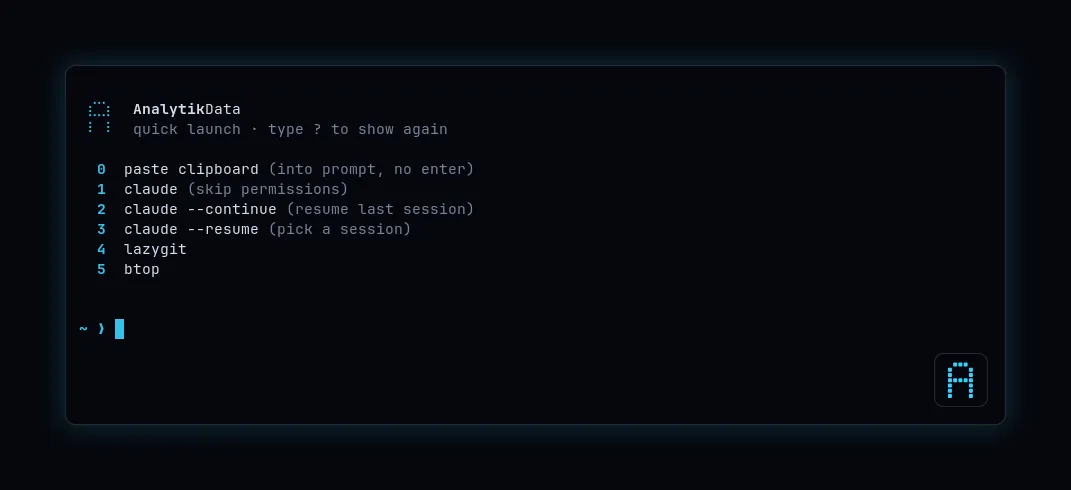
That is why every new terminal now greets you with a small menu:

A fresh terminal with the quick-launch menu: numbered shortcuts from “paste clipboard” to btop

Type a digit, hit Enter, go. Technically this is unspectacular — and that is exactly the point. It is Bash aliases (yes, 1 is a valid alias name) plus a small function that shows the menu only in fresh terminals, not in nested shells (abridged here):

alias 1='claude --dangerously-skip-permissions'
alias 2='claude --continue --dangerously-skip-permissions'
alias 3='claude --resume --dangerously-skip-permissions'

quick_menu() {
  echo "Quick launch  (type ? to show again)"
  echo "  1  claude (skip permissions)"
  echo "  2  claude --continue (resume last session)"
  echo "  3  claude --resume (pick a session)"
}
alias ?='quick_menu'

[[ $SHLVL -le 1 ]] && quick_menu

About twenty lines of Bash. The agent wrote them itself, tested them (including the question of what shell nesting depth a fresh terminal under Hyprland actually has) and documented them in the inventory — effort: a few minutes of shouting instructions into the chat.

An honest note belongs here: key 1 starts the agent in autonomous mode, that is, without asking back on individual actions. On a machine of your own, encrypted, where everything important lives in Git, that is a deliberate trade of control for speed. You should make it deliberately — which is why it is stated here.

Hand-sized jobs like this come up daily for us. Individually they are too small for a blog post — hence this new section: short notes from the ongoing rebuild, unfiltered and in real time. The long stories will keep appearing on the blog.

Reactions

This is what we do — for SMEs

What reads as field notes here is what we build for companies: step by step, audit-proof, no buzzword fog.

Become AI-ready →Untangle legacy systems →Let's talk

News in your inbox — your way

Per post, per note, daily or weekly bundled — you choose. No sharing, no spam, unsubscribe with one click — hosted in Switzerland.

AnalytikData

We make grown SMEs future-ready — audit-proof with Coautra.

ImprintPrivacyAnalytics opt-outmr@anadat.ch
ServicesBecome AI-readyUntangle legacy systemsCookie-free web analyticsChannels & news
ReadHow we workNewsTicker — installable app (DE)WorksStore
FollowLinkedInBlueskyMastodon/FediverseNewsletter
FeedsRSS BlogRSS NewsRSS Ticker

© 2026 AnalytikData GmbH · All rights reserved.·

Sprache / Language

|